Showing posts with label wheatbelt. Show all posts

Tuesday, March 31, 2026

Malice and Cruelty Towards Corellas in the WA Wheatbelt

A generalised hatred of corellas in the wheatbelt is remorseless and obvious. Not only do shires carry out ruthless culling, but if one hears corellas coming into a zone, it’s inevitable that gunfire will follow. I’ve been writing about this for decades, and all that happens is I have an index of poems lamenting the violence, the aggression, the excuses for cruelty.

And the excuses meted out by the killers? That the birds are an agricultural pest. Everyone who lives here knows about their loss of habitat — less than 3 percent of pre-colonial vegetation remains in the wheatbelt — and everyone knows that the birds are managing their environment in the best ways open to them.


Everyone knows that these are flocking birds with complex social interactions, and everyone knows that arguments around them being ‘invaders’ are ludicrous. Further, everyone knows that these birds are considered ‘fair game’ across various parts of Australia and are treated as animals without any rights. Western and little corellas live in the paradox of being ‘protected’ under the 2016 Biodiversity Act and also being labelled an agricultural pest.


I have intervened in culls (York 2003/4), written poems and stories against them, and recorded observations in an attempt to oppose them. I am not alone in this — many others have spoken, written, and campaigned against the slaughter, and continue to do so. There was a recent mass cull across a number of shires in the ‘Avon Valley’, and that has also brought an outcry, as it should.


But until the mistreatment of these birds and many other animals across the wheatbelt is highlighted, and until shooting while arguing on the grounds of the common good (‘anti-feralism’) is shown to be an hypocrisy (sport gained out of killing), and the other methods of killing exposed for their cruelty, this will continue. Grain growing areas are inevitably going to ‘collide’ with the wildlife that have been ousted, but rather than this kind of abuse of animal rights, it seems essential that more areas are set aside for these creatures, and that non-violent means of working towards a co-existence are investigated and put into practice.


Apropos of all this, indifference to targeted animals becomes a masking of cruelty. The other day we witnessed someone calmly driving their car over a stunned corella (but standing and surrounded by other birds)  — literally crushing it under their tyre. Did they perceive this as a ‘mercy killing’ (what a sick concept — ‘putting out of its misery’) or did they just see themselves as extending the cull? It happened next to the Northam Grain Terminal, where corella shooting is a regular occurrence (I wrote and published a story relating to this last year), and the roadside was a display of battered corpses.


What was one more corella? It was a sentient life. It was in need of help which could easily have been provided by a vet or animal care worker.


Before we could intervene, the deed was done and the driver left the scene, slowly returning to the speed limit. People who treat animals with cruelty are also capable of treating humans the same way. This poem is part of a collaborative work I am involved with which acts as witness, but really, the actions have to be on a personal level across the entire community. Some are speaking out; may many more.


Malice


In the age

of the short

attention

span


a white car

approaches

arrangements

of white

feathers —


a clutch

of corellas

on the road

alongside

the great

A-class

wheat bin

(longer

than

a ship);


one of the birds

has been injured

and rocks

back

& forth,

tended by

its companions


the white car

glides then slows

and almost stops

before the driver

guns the motor,

crushing

the injured,

shocking

those birds

tending;


it’s as specialised

an act of cruelty

as I’ve ever

witnessed,


deliberate

as a war

crime.


JK


NOTE: looking through my old emails, I find message after message to shires protesting corella culls. These spread over many years and are directed towards York, Northam and Toodyay shires. And I found this poem I sent to the Northam shire. It's never made a difference, though not for want of trying. I found an email where Tracy points out one woman who tried to stop an earlier cull.


Dawn Corella Asks to be Let Live: against the 2020 Northam ‘Corella Cull’


On returning after being away and hearing corellas at dawn


As if survival of dawn and call

is a matter of word sparkle —

a quid pro quo you expect from ‘art’,

a gift of zest and boost of the beautiful.


How so when so many of you won’t stand 

for the art of corella, the collaborative

art, the voicings of faith and fascination,

the line through darkness that gives?


When the cullers come to cull 

ask how many are getting a bit of sport 

out of it — the kill that plays with ‘skill’,

the art of the dawn call’s bloody fall.


John Kinsella


Thursday, June 29, 2017

More on Parrots


Below are answers I gave to a series of questions sent to me (mid 2015, I answered January, 2016) but never presented or used in any specific way:

*parrots have always been 'central' to what i do for three reasons:

(1) they were always around me at wheatlands farm - i loved them and yet i shot them as a child and that contradiction was one of the driving forces that led me to animal-rights activism and veganism (see a recent animal-rights poem just up at [this blog].
(2) as a child i also trapped them out on the big farm my father managed near mullewa, and then incarcerated them in cages down south. watching their tragedy unfold awakened me to what i was doing. i was saturated in the suffering i had caused.
(3) they have become more than symbol to me, more than 'transitional objects', they are real accompaniments to my life in the wheatbelt and i to theirs. i feel an advocate for their rights, and try to create space for their nesting and lives.

*i spent many years of my childhood living in mount pleasant by the river, though we spent as much time as possible on wheatlands farm. we then later moved to geraldton. and i spent time, with my brother, up north with my father on access visits and holidays, and also on the farm near mullewa he managed. i have lived in fremantle and south perth (twice), i have also lived in northbridge and for a time in the globe hotel (gone now) in perth. i wrote a series of city-dwelling poems which were published as a chapbook by vallum. they are entitled 'inner city poems'. more of my suburban poems - always about space - are to be found in the book i did with robert drewe entitled sand (fremantle press). the wheatbelt has been the main focus and living place of my 'australian' life, but i have (long ago) spent periods in the city. i lived on the streets for a considerable time when i was alcoholic/addicted for those many years. twenty years sober now. i associate the city with lostness, confusion and confinement re space because of the cycle of self-abuse.

*i think birds are a spatial release for suburbs - they are hope and transcendence. when i wandered the dark lonely places of suburban enclosure (consider john clare and enclosure), i literally communed with birds by way of sharing. i sought to protect them and they gave back. 'introduced species' of birds make their place where native birds have been destroyed, and they in turn enrich the ecology and allow for other birds to co-exist. people who shoot pigeons and rainbow lorikeets etc in the suburbs are an outrage - in the context of 'invasive species'. what a cheek! aviary escapees, native species (especially the wonderful carnaby's) and other species that have gained traction, should be protected and nurtured. for themselves, primarily, but also because they offer understanding of the world at large, realign and free the spatial constraints of the city, and show that there is more to the world than 'owning' animals and owning space. suburbs are about control - birds break down that control in non-violent liberating ways, they can share, why don't we?

a poetics of bird-spatiality in the city.


john kinsella

Monday, May 8, 2017

Wheatbelt Stubble Burns and Fencing Are Just Other Methods of Clearing Native Vegetation

 
   by John

This poem is in response to the atrocity of stubble-burning going on at the moment in wheatbelt Western Australia. We have spent two months under smoke from pointless and damaging burns. In the extreme dry (no rain!) the stubble has easily lent itself to complete burnouts of surrounding bushland. And so many old-growth trees left in paddocks are now burnt to ash. A disgrace! And there's a binge of fencing going on, with fencers (and landowners) removing as much vegetation as they think they can get away with.


Graphology Endgame 74: burn testament burn-off


(i)

The burn-off racket. The windrows flame out.
The oops, it got away from us — fire having its way.

Blokes in hi-vis jackets light the stubble & evaporate.
Highlights to flame against, smoke dousing bees

where manna-wattles blossom now on edges,
so eruptive to nakedness, the raw combustion.

Don’t separate off napalm in the farming-out
of warfare — contrast victor and conquered. Don’t

lose track of parodic elements, those satellite furphies
to barely catch out the wanton, the collateral exposé.

Firebreaks ignored when razing the fence-line.
Lexical endgame in ‘out of control’; afraid there’s no

conservation cropping going on here, just burning
regimes to mock retention. Stubble binds. Stubble burns.

A week later, we’re back on the same road to witness
the entire bush-residue burnt out — the hop, skip and a jump

from paddock to enclave. Ash complements emptiness.
Summer’s fire-plan is autumn’s clearance sale in action.

Where we’d admired tall York gums in the centre of a paddock,
along the spine of the eroded Dyott Range, we see emptiness.

Fire climbed into branches and wiped out eras of nests.
Ash and charcoal ploughed into the loam — warped fertility.

We see power-poles in paddocks protected from the burning —
thus the selective nature of ‘accidents’. Growth as mechanism.

We have lived in a humidicrib of smoke for two months. Singed
and coated lungs. Landowners burning out the heart of here

as vengeance against the dry, against the ecosphere
for telling them what’s what. No rain means more flame.

In this age of destruction, we are expected to keep
our mouths shut and cop what’s ‘good’ for us?


(ii)

In this long dry, flames reach higher and it’s a gamble
grabbed with both hands: the fire-starters thirsty

for every extra bag of grain or hay-bale they can eke out.
Shot-term visionaries of the aggro-cultivated balance sheet.

And where flames don’t wipe out the remaining trees,
bring in the fencers! — excise every last tree along roadsides,

extended domains of felling. These tricks of demolition — scrolling,
rolling up. Work that into lines of rhyming iambic pentameter —

a colonial metre; or better still, make comment
and enjoy the indifference of movies or game-stations

in open forms. Poetry accommodates what is as long
as it sparkles in display — pseudo-ritualistic burning-off

being the way of it, the sun a red goitre in the encarboned sky.
And Stephen Hawking, O prophet of humanity, instructs us

that ‘resources’ will be used up (too fast, too fast) within a hundred years,
not a thousand, and we’d better hop to it and get out there

colonising space (I thought that’s what had been happening
all along). Hawking might like to visit the Western Australian

wheatbelt to see humans cutting off their noses to spite
all other faces, to see the eco-system of a tree

go up in smoke at the one time of year
we might hope to avoid bushfires — this

is the psychology and skills we’ll take out there
from here, the green eye on green planets to make bare.

The smoke of lit fires across the planet blankets
the future. It hasn’t rained and the farmers

can’t crop so they burn (working hard — leaving
the burning unattended) — to expand, to make ready,

to add the quintessence of their agriculture
to cracking the world’s pastoral-ismo enigma code.

The feeders, the fed, the feeding: eat what’s served up
on our plates. Not every farmer, of course — no one size

fits all, but people stand and suffocate bewildered,
not knowing what to do. Firies who fight summer fires

light late-autumn fires and have a barbecue afterwards.
Just one scenario, but it’s all in play at the moment.

And those few colonisers out there, who will wreak
development on other worlds, will think back to what

they’ve left, the billions dying, and say, all those plumes
of smoke, those destroyed trees, those genetically

modified crops replacing evolution. For our sakes.
We carry the genes of Stephen Hawking

in phials around our necks: ancestry,
the burning that brought false fertility

hard to pick out on this bloody
and smoky event horizon we cease under.


(iii)

We are not alone. A letter to the Toodyay paper
pointing out that such burning-off is illegal.

And another in the York paper. Rain doesn’t
come, so the burning continues. Into the ash,

the GM canola implants. Air-seeders,
dust plumes. Last year there were families

in the crops — bumper green — to leitmotif
the media. Happy families as the earth contracts.


(iv)

The colours of a polluted sunset are simply awe-inspiring.
I won’t fill in the wild and muted and angry colour chart —

that’s just a little indulgent, isn’t it? Giving you something
sensuous to get a grip on, dig your teeth into. That’d be

making art out of the horror — finding beauty in the
last gasp. But I’ve seen many land-owners standing

on the edge of their spreads (it’s the year of America)
admiring their handiwork, the kickbacks of nature.


(v)

The eagle flying mid-range between the burning
and the hills, waiting for the dash of rodents
and even reptiles who are this way and that
with the late heat, the dry, but shorter days.

The eagle flying mid-range between the burning
and the hills, watches its eyrie flamed-out of the tall tree
that has survived the bushfire seasons to be ashed
so the tractor can get a clear run on profit’s ingress.


(vi)

In Ireland it’s blasphemy to question God’s
ironies of fire and water — the conflagration
that has turned even bones to ash. It’s all
goodness on the statute books, and local
spirits know what’s good for them
as the earth is made bare; even
that place of the Saint Finbarr —
Gougane Barra — watching the mountains
in flames, the vegetation rising as cinders
to make false haloes over the lake.
Gorse fires without restraint.
Consequences. Subtexts. Blasphemies.


(vii)

Harvest of flame.
Time and a place.

Now a consequence
for nature that has

nowhere else to go.
Harvest of flame,

the world’s punishment
for suggesting ‘restraint’.

All that precedent
lost to the industrial

grotesque — the natural,
the ritualistic, all dragged

into the coffers; the products
we ‘need to have’, force-

fed, choking on abundance,
harvest of flame.


(viii)

Sick moon? What is
the magpie mimicking?

And the mistletoebird?

The trees knocked over by the digger
and burnt — we saw it happening.

No gathering to stop it.

Nothing. No case
to answer. Sick moon?

You rise large and diminish.
Consortiums and governments

are aiming to mine you soon. Soon.
Burnt off constantly by the sun.

Tawny frogmouths
suffocated by smoke.

On the moon, too — see them fly past,
and fall. Less gravity, but enough

to bring down, to hold the dead.
Evening star — fire-starter?

Tawny frogmouth — smoke ghost.

The gods are alive and walking
and flying and swimming and crawling

and existing on the earth — today,
and for the last couple of months,

Gods here have been burnt out
under the camouflage of burning-off,

of adding trace elements to a soon-to-be
heavily fertilised soil, to remove

the inconvenient chaff piles
and trees, of replacing

fences with new fences
and clearing vegetation

as process. These live gods
made dead. Multiplying

but finite blasphemies.
Evening star — fire-starter?

Nocturnal day-walkers.

Bruised clouds.


(ix)

You dare compare your acts
with the use of fire by Aboriginal people
as a means of being one with their country?

You dare compare your acts
with the use of fire by Aboriginal people
as you burn country you stole from them?

You dare compare your acts
with the use of fire by Aboriginal people
when you divide and conquer, leave nothing alive?


(x)

Smoulder. Rouse. Conflagrate.
It’s easy to balance the equation.
Emulsified testament suspension.
Conflagrate. Rouse. Smoulder.


-->
            John Kinsella

Friday, February 10, 2017

Extreme Weather Conditions in the Avon Valley and Central Wheatbelt of Western Australia


            by John Kinsella


‘Extreme weather conditions’ — we hear that a lot. This summer has been psychotic. From 45 degrees centigrade (a few weeks ago) to 17 degrees centigrade (yesterday); from a dry that eviscerates to deluges that have broken all records. 

As things have been progressing, it's become clear that our concerns are mild compared to many people's. This is a major set of weather events that is having catastrophic consequences in some places, and the Avon's flooding is severe -- whole towns are being cut off. This blog entry reflects only some recent experiences.

Last Monday and Tuesday we received 160 mm of rain, and I spent Tuesday morning digging ditches and channels to release water gathered behind the house, trapped on its cascading ‘got to go somewhere’ run down the hillside. Gutters couldn’t cope, the ground destabilised, and old-growth trees tilted.

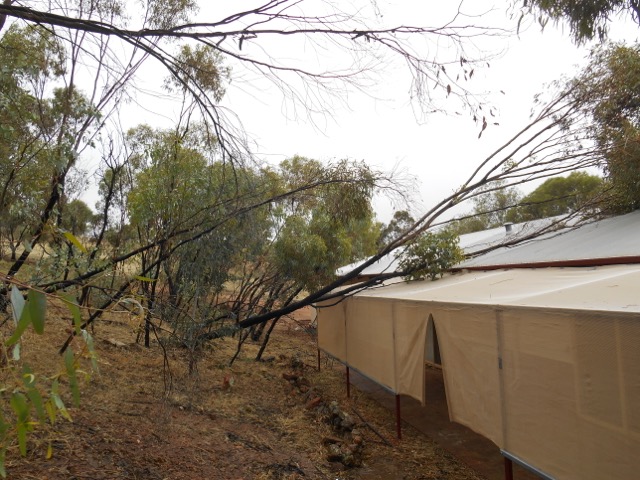
And then last night we received another dose of 75 mm, and woke to a tree down on the shade-cloth frame and the house roof. I had lain awake through much of the night and heard an almighty crash, and at first light looked out to the east because I suspected we might lose one of the trees out that way, but it was still standing.

Then Tim noticed one of the magnificent old-growth York gums down, one that grows on the tier above the house, just below the red shed’s level. Only two days ago I had caught a glimpse of a sleeping tawny frogmouth in the fork of its upper branches — numerous ring-necked parrots and galahs roosted in those branches, and it was part of the territorial stations of magpies and many other birds. Song-birds thrived in its blooms and around its lower branches.

But the tree that had likely made the crashing sound that alarmed me, was a younger tree, nonetheless quite tall, which had been uprooted and collapsed. I thought we’d have to call the SES, but decided to deal with it myself, given there was no hole in the roof, and given the pressure all services are under with flooding throughout the southwest, and given that we couldn’t expect assistance from our reliable friend John (‘Guru’), my mother’s partner, because they are literally flooded-in over near York, and their block is experiencing torrents.

York Gum down on house — trunk is about 20cm thick  at maximum and the whole was bringing a considerable
weight to bear. Sad loss.

Anyway, I spent an age working out the best way of dealing with the tree, sans a chainsaw (which I refuse to possess or use), and avoiding further damage to the roof.

I managed, using a bow saw, to cut the lower trunk partially, so it hinged down, lessening the load on frame, roof and trunk, and then once that load had been more evenly distributed, cut through and slide it from the roof.

I did the same with the next branch, and with some help from Tracy, we managed to ease the thick limbs down and away. Then I cut segments of the trunk down bit by bit. It was slow and dangerous work with the ground very unstable but it was done. I had then to saw up the tree and remove because over the next couple of weeks the fire risk will inevitably rise to ‘severe’ or even ‘catastrophic’ again, and we just can’t have swathes of eucalyptus leaves and branches piled up, drying close to the house.

As we deal with these bizarre weather patterns, tropical lows coming down fast from the north and cold fronts coming in west, I think of the fools in Parliament in Canberra taking lumps of coal in to make points about energy production.

We have handed our rights to self-determination and the rights of the biosphere over to fools. They live in their air-conditioned bubbles (in their mansions, in their offices, in the parliament, on their tractors) and can’t make simple links between cause and effect.

And here in Western Australia, the Western Australian government, private industry, and Main Roads, destroy every bit of vegetation they can lay their hands on. Cause and effect. Climate models. They want to live their lives now, without care for the future, and extract all they can. It’s brutal, selfish, and malignant.

So the reports are coming in: areas of Northam Shire are under evacuation orders as the Avon River rapidly rises. York is expecting a 4-metre peak and Toodyay similar. Walls of water moving fast and not to be toyed with.

There was no brook, stream, or winter creek here before — water is making its own way down to the Avon River from behind my mother's house.


Above photos taken by Wendy Kinsella over at York


Strangely, dealing with limbs of the old-growth tree pressing on other trees, and sawing away with the bow saw to relieve the pressure on those other trees already stressed with the softened ground, I noticed, in all the dirt thrown up around the torn and broken roots of the tree, clods of dry soil emerged from deep beneath its centre. I felt a weird anti-abjection that with all the mud and sogginess around actually made me viscerally sick, so incongruous was it.

Nearby was a puffball that had burst and set like concrete in the heat, and then being soaked in the deluge, had developed a black, mouldy patina. It was otherworldly, alien, and upset expectations of observation.

The entire landscape seems to have been given an injection of ghost, and the water still rushes out of the rocky soils of the hills, and gathers and flows down ‘Bird Gully’ to the valley below, to the valley where ancient flooded-gums had been burnt to their cores when someone’s burning-off got out of control some years ago. The dead trees parody their living selves sucking up no water, and the pobblebonks are always hidden mad in mid-summer with calling to the weirdness, the haunting. It’s like that, walking the bloody firebreaks, a skein of green coming up in the paddocks.

And so I write a poem, because it’s how I process disparate information, make sense of disjunctions between how I see something and how I experience it.

These trees we struggle for, watch daily as life evolves and revolves around them. I think of the wounds being inflicted along roadside, in paddocks, at the Beeliar wetlands, in nature reserves when someone wanting to fence makes more room for themselves, breaching the private and public, neo-colonists, and the broken, disrupted surfaces washing away under the deluge, and when the heat comes back fast and soon, blowing away as dust.

Everywhere around the district are new fences, and all the vegetation the fencers find an excuse to dismiss from life. And not far, those secretive ‘small-scale’ bauxite mines on private land, sending the essence of ecologies away to smelters. And few know, and few listen, so many struggles happening everywhere at once.

And so I write a poem, one of my new ‘Graphology Endgame’ series. Number 25, they are gathering. The lines are showing me a way I don’t wish to take, but am compelled to:

For all our preparations —
fixing gutters, making channels,
ensuring flows are as clear
as possible, the next instalment
of The Flood comes and puts
us in our place by dislodging
expectations — and then
a tree on dwelling,
our habits shaken,
and a bow-saw violining
the limbs, the trunk — that cutting
we push back against
in every other way,
always. Wetted soil,
dry at the core,
to replant
between extreme
weather conditions.
And tend. And let be.
-->

-->