Written by John, posted by Tracy
This is just to wish well all those in the central wheatbelt who were affected by Saturday’s horror storms. We will never forget the day the red cloud arrived and ate the sky, and, indeed, the world. I was outside securing loose stuff on the block because I’d heard a storm was approaching. I looked up and in the north-east a bizarre red-black plume was billowing, cascading, and looming. I thought it was a fast-moving fire and we were finished. But there was no smell of smoke, no burning at the back of the throat.
I called Tracy out to take a look and by the time she got there the cloud was massive and red and almost on us. We ran inside and shut the door. Everything went red-black and then black, though it was 2.45 in the afternoon. A thunderous rush of air, like a vacuum being filled instantly, rocked the house. Winds that must have hit 120kmh suddenly ripped in like whirlpools. The trees on the block whipped across the screen of the window before vanishing into the red-black howling. We didn’t think anything would be left, or that the house would be left standing. But it was.
However, many in Northam and York lost roofs and much more. Mum’s place, where we lived for many years, was devastated. Barely a tree was left intact. Old York gums and flooded gums were splintered, jam trees ripped out by the roots. A neighbour’s house lost its roof, another neighbour’s parts of the roof and infrastructure of the house. The entire town is in ruins. And apart from the trauma experienced by humans in the area, birds and animal life are disturbed and stressed.
Our house has since filled with various species of ants, frenziedly crossing from one room to another in their desire to move, move, move.
So please spare a thought for those affected: it has been a time of huge disasters in Australia, and when they happen out in the bush and on a more ‘isolated’ scale, they are easily subsumed into the whole. Many of our young son’s schoolfriends from his old school have no roof (literally) over their heads, and it’s a tough, tough time. I find it surreal and disturbing that the place I wrote for so many years, where I set my Divine Comedy, has truly seen heaven, hell, and purgatory crunched together.
I’d heard a storm was approaching and Tracy rang Mum to let her know. Shortly after, Mum looked out the back window and a vast red wave rushed down over the mountain and enveloped the house. The chimney went, and they waited for the rest of the house to go too, but it hung together. The red cloud — full of red dust from further north (it was the colour of the dust around Yalgoo and Mt Magnet, where we have recently been) — ate the sun, ate the light, and ate the district. Apologies for the mass of descriptors, but it was that overwhelming. It was like being inside a thesaurus that didn’t have enough words. It’s a case of letting the experience rush out or remain forever silent, it was that dramatic and that indelible. It will mark all our lives.
Monday, January 31, 2011

Sunday, December 26, 2010
Some Graphology poems from the journey
Poems and text by John, posted by Tracy
From John's journal: I've written a number of 'graphology poems' relating to our journey to Adelaide and back. I have written four or five sequences (including Poet in A Train, which Vallum editions brought out in Canada) relating to this west-east journey, but all have been from the perspective of a train passenger. Because I no longer fly, I have gone across the Nullarbor a number of times on the train over the last few years. (Obviously the train is better than the car, but there were three of us on this occasion.)
Driving across with Tracy and Tim was a very different experience. Whole different insights and interactions with place. The collective experience of engagement en famille was special and enlightening. Some of the poems I wrote during the journey were actively part of the manuscript I have been working on recently, Book 6, which comes out of an engagement with Virgil's Aeneid, Book 6, as a precursor to Dante's Divine Comedy, and my own 'distraction' on Dante's great work. But I've also written a dozen 'graphology poems' - smaller, momentary 'glimpse' pieces that fit within the fabric of the 'graphology' sequence I have been working on for the last fifteen or so years. The numbering is sequential but also arbitrary in so far as I have not written 3000 (or 4000 or 7000!) of them, as numbering at times might suggest; rather, it is to create a location canvas on which the interludes might appear. Numbers and texts seem so closely related to me, and to be bound to one kind of sequencing is to miss the point of the vitality of number 'screens'.
I also scratched or created poems in dirt and sand on the way, 'poems of dissolution' that would have vanished once the wind lifted or animals scratched at their surface. I recall one night going out into the saltbush and bluebush and ubiquitous wild oats you find fringing those small points of habitation along the highway, and listening to and watching in the moonlight hundreds of rabbits moving about. Parts of the limestone plain have become 'their' plain in so many ways. And the wedgetails which scan the ground during the day. I wrote a poem there - scratched with the point of my boot in the limestone dust, and then on the page. Might get to typing that one up.
One of the experiences that will really stick with me was driving through the length of the South Australian wheatbelt - knowing the West's wheatbelt so well, it was equally engaging and distressing to see the vast monoculture of beige and bisque and off-gold in another space, on the edge of the vast dry, though in fact it rained as we passed through. And the great yields they are getting this year as opposed to the drought-ridden minimalism of the west. The ironies are the same. My being enraptured with those ironies slightly out of kilter, a little uncanny, but feeding on the same impulses. The Goyder Line is much further north - it's the line beyond which the pastoral fails in many ways due to dryness. I was thinking of another imaginary southern line where wheat-growing fails. In the west, they keep clearing further and further out beyond wheat-growing reality, wasting scrubland for a yield every few years. Insanity. And as they clear the scrub, the rain lessens and the land erodes, and is peeled away by the winds.
Graphology 3732
Prior to departure east
an all-black black-headed monitor
swaggered — I say this in the way
young Tim imitates my walk
from behind as male habit,
when in fact my swagger comes
from watching monitors
and is, I’d like to think,
largely unconscious — swaggered
the range of the window, hunting
sand between ridge and house.
Magnificent! Then, days later
on the Bight, at 'observation
point two' we passed the first time
round, crossing over (now,
we’re talking back, and west),
a skink and a gecko on stone,
in bluebush and saltbush;
I didn’t identify them
precisely though if I think about
their gait, twist, slither,
I will come up with something.
Names, imitations. Imprints
of character.
Graphology 3735: dingo
‘Best friend’ dash,
road parsed,
ditch diver
salmon gum
goldfields blackbutt
drain where litter
might well shelter,
daylight bright
on mother’s yellow coat.
Overwhelming
involvement: wild dog! wild dog!
feed your fear,
this side of the endless
endless fence.
Graphology 3737
Superpit
true grit
induced
earthquake
historic centre
Boulder
cracked
but NO
cause
& effect.
Graphology 3738: South Australian wheatbelt bandwidth
What is wheat’s Goyder line?
Counties and hundreds,
mono beneath the hammock,
filled to the gills of the boot,
granary of foreign exchange,
returned servicemen
answering calls of nature
we see those homesteads
enveloped in opening,
at most, windbreaks
of pines, imported.
Drive from mallee
dust as dry as fallow,
lessen rust. And, sad
to say, I got excited.
John Kinsella
From John's journal: I've written a number of 'graphology poems' relating to our journey to Adelaide and back. I have written four or five sequences (including Poet in A Train, which Vallum editions brought out in Canada) relating to this west-east journey, but all have been from the perspective of a train passenger. Because I no longer fly, I have gone across the Nullarbor a number of times on the train over the last few years. (Obviously the train is better than the car, but there were three of us on this occasion.)
Driving across with Tracy and Tim was a very different experience. Whole different insights and interactions with place. The collective experience of engagement en famille was special and enlightening. Some of the poems I wrote during the journey were actively part of the manuscript I have been working on recently, Book 6, which comes out of an engagement with Virgil's Aeneid, Book 6, as a precursor to Dante's Divine Comedy, and my own 'distraction' on Dante's great work. But I've also written a dozen 'graphology poems' - smaller, momentary 'glimpse' pieces that fit within the fabric of the 'graphology' sequence I have been working on for the last fifteen or so years. The numbering is sequential but also arbitrary in so far as I have not written 3000 (or 4000 or 7000!) of them, as numbering at times might suggest; rather, it is to create a location canvas on which the interludes might appear. Numbers and texts seem so closely related to me, and to be bound to one kind of sequencing is to miss the point of the vitality of number 'screens'.
I also scratched or created poems in dirt and sand on the way, 'poems of dissolution' that would have vanished once the wind lifted or animals scratched at their surface. I recall one night going out into the saltbush and bluebush and ubiquitous wild oats you find fringing those small points of habitation along the highway, and listening to and watching in the moonlight hundreds of rabbits moving about. Parts of the limestone plain have become 'their' plain in so many ways. And the wedgetails which scan the ground during the day. I wrote a poem there - scratched with the point of my boot in the limestone dust, and then on the page. Might get to typing that one up.
One of the experiences that will really stick with me was driving through the length of the South Australian wheatbelt - knowing the West's wheatbelt so well, it was equally engaging and distressing to see the vast monoculture of beige and bisque and off-gold in another space, on the edge of the vast dry, though in fact it rained as we passed through. And the great yields they are getting this year as opposed to the drought-ridden minimalism of the west. The ironies are the same. My being enraptured with those ironies slightly out of kilter, a little uncanny, but feeding on the same impulses. The Goyder Line is much further north - it's the line beyond which the pastoral fails in many ways due to dryness. I was thinking of another imaginary southern line where wheat-growing fails. In the west, they keep clearing further and further out beyond wheat-growing reality, wasting scrubland for a yield every few years. Insanity. And as they clear the scrub, the rain lessens and the land erodes, and is peeled away by the winds.
Graphology 3732
Prior to departure east
an all-black black-headed monitor
swaggered — I say this in the way
young Tim imitates my walk
from behind as male habit,
when in fact my swagger comes
from watching monitors
and is, I’d like to think,
largely unconscious — swaggered
the range of the window, hunting
sand between ridge and house.
Magnificent! Then, days later
on the Bight, at 'observation
point two' we passed the first time
round, crossing over (now,
we’re talking back, and west),
a skink and a gecko on stone,
in bluebush and saltbush;
I didn’t identify them
precisely though if I think about
their gait, twist, slither,
I will come up with something.
Names, imitations. Imprints
of character.
Graphology 3735: dingo
‘Best friend’ dash,
road parsed,
ditch diver
salmon gum
goldfields blackbutt
drain where litter
might well shelter,
daylight bright
on mother’s yellow coat.
Overwhelming
involvement: wild dog! wild dog!
feed your fear,
this side of the endless
endless fence.
Graphology 3737
Superpit
true grit
induced
earthquake
historic centre
Boulder
cracked
but NO
cause
& effect.
Graphology 3738: South Australian wheatbelt bandwidth
What is wheat’s Goyder line?
Counties and hundreds,
mono beneath the hammock,
filled to the gills of the boot,
granary of foreign exchange,
returned servicemen
answering calls of nature
we see those homesteads
enveloped in opening,
at most, windbreaks
of pines, imported.
Drive from mallee
dust as dry as fallow,
lessen rust. And, sad
to say, I got excited.
John Kinsella
Monday, December 20, 2010
Crossing the Nullarbor
Posted by Tracy; photos by both of us.

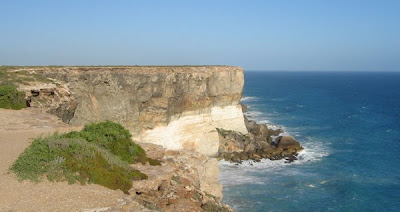
The cliffs at the Great Australian Bight. These magnificent cliffs run for hundreds of kilometres along the bottom edge of Australia. East of Eucla they are called the Bunda Cliffs; in the west, the Baxter Cliffs. Together they're apparently about 400km long.
I first saw them when I was twenty and have never forgotten it. Seeing them again was even better.
There is a section of the Nullarbor where the cliffs run inland, forming the edge of the Hampton Tableland; below it are the Roe Plains. This photo, taken at Madura Pass, looks out to the Roe Plains from up on the Tableland. Madura Pass is one of the highlights of the journey.

I wish I had taken a photo of the moonlit Nullarbor, achingly beautiful -- it makes you want to lie flat on your back on the ground and just stare at the sky.
There's a detailed book about the Nullarbor by Neville Collins, The Nullarbor Plain: A History, including many striking photographs. It surveys the region's Aboriginal history as well as colonial incursions, and has other sections covering everything from flora and fauna through UFO claims, hoaxes, space debris (Skylab fell near Balladonia, on the western edge of the Nullarbor, in 1979), to meteorite finds and nuclear testing. Collins was born at Ceduna in South Australia, to the east of the Plain.

The cliffs at the Great Australian Bight. These magnificent cliffs run for hundreds of kilometres along the bottom edge of Australia. East of Eucla they are called the Bunda Cliffs; in the west, the Baxter Cliffs. Together they're apparently about 400km long.
I first saw them when I was twenty and have never forgotten it. Seeing them again was even better.

There is a section of the Nullarbor where the cliffs run inland, forming the edge of the Hampton Tableland; below it are the Roe Plains. This photo, taken at Madura Pass, looks out to the Roe Plains from up on the Tableland. Madura Pass is one of the highlights of the journey.

I wish I had taken a photo of the moonlit Nullarbor, achingly beautiful -- it makes you want to lie flat on your back on the ground and just stare at the sky.
There's a detailed book about the Nullarbor by Neville Collins, The Nullarbor Plain: A History, including many striking photographs. It surveys the region's Aboriginal history as well as colonial incursions, and has other sections covering everything from flora and fauna through UFO claims, hoaxes, space debris (Skylab fell near Balladonia, on the western edge of the Nullarbor, in 1979), to meteorite finds and nuclear testing. Collins was born at Ceduna in South Australia, to the east of the Plain.
Friday, December 3, 2010
Musselwhite Extract #2: Tess
By Tracy
This is from David Musselwhite's 2003 book, Social Transformations in Hardy's Tragic Novels: Megamachines and Phantasms.
Even in this glimpse of only one chapter* of Social Transformations..., we can see David's typical ability to think things through from an "opposite" angle, to consider Tess as see-r and not just seen; and the outlandish but exact and just image of something unexpected (Tess as a dictionary-accessory!). The theoretical underpinnings of the book, again in Deleuze and Guattari but even more extensively in Laplanche and Pontalis's work on the "phantasm" are too complex to paraphrase here -- so I urge anyone interested to get hold of Social Transformations for themselves.
*There are actually two chapters on Tess in this book. The other novels studied are The Mayor of Casterbridge, Jude the Obscure (also two chapters) and The Well-Beloved.
This is from David Musselwhite's 2003 book, Social Transformations in Hardy's Tragic Novels: Megamachines and Phantasms.
... in Tess, Hardy seems to be working with a wholly new conception of what is entailed in the 'construction' of a 'character' or of a 'consciousness' -- a conception that finds parallels in the psychoanalytical notion of the phantasm where the human becomes human -- acquires character and consciousness -- when the accumulated and consorted bruit or dit -- the lore -- of the tradition or the culture becomes accreted around and inscribed on the blank surface of the physiological body...
...In a sense what Tess becomes is a kind of 'phenomenological palimpsest' -- or, to recall another favourite image of Freud for the unconsciousness, a 'magic writing block' -- of all that she unconsciously registers of what has been said or thought about her, of all that has anticipated and been brought to bear upon her, of all the phantasmatic events that she has passed through. What this means is that Tess becomes something like an 'expressive digest', or 'phenomenological prism' of the world into which she has been born -- a world not just of material conditions but of a host of pre-existing roles, attributes and singularities. I think this accords well, in fact, with what we sense of her luminous presence. Much has been made of Tess as the object of voyeuristic fantasy but much less has been said of the degree to which we see the world through her. Indeed at times in the course of the text Tess seems to function like an 'expressive cursor' or like one of those ruler magnifying glasses that come with miniaturised editions of the Complete Oxford Dictionary. (p. 117)
Even in this glimpse of only one chapter* of Social Transformations..., we can see David's typical ability to think things through from an "opposite" angle, to consider Tess as see-r and not just seen; and the outlandish but exact and just image of something unexpected (Tess as a dictionary-accessory!). The theoretical underpinnings of the book, again in Deleuze and Guattari but even more extensively in Laplanche and Pontalis's work on the "phantasm" are too complex to paraphrase here -- so I urge anyone interested to get hold of Social Transformations for themselves.
*There are actually two chapters on Tess in this book. The other novels studied are The Mayor of Casterbridge, Jude the Obscure (also two chapters) and The Well-Beloved.
Musselwhite Extract #1: The Monster
By Tracy
Today would have been David Musselwhite's 70th birthday (he passed away in February this year). In our writers' group today we read an Emily Brontë poem he particularly admired. Now in honour and memory of David, I want to redirect people to his marvellous books, beginning with 1987's Partings Welded Together: Politics and Desire in the Nineteenth-Century English Novel.
In this book there are wonderful chapters on Austen, Brontë, Thackeray and Dickens, but for me most strikingly of all on Mary Shelley. Here's a characteristic quote from "Frankenstein: The Making of a Monster":
The chapter on Emily Brontë is also original, inventive and memorable -- in one of David's obituaries, UK academic Gary Day said,
In the book's appendix there is an extremely useful entrée to the ideas of Deleuze and Guattari, included to provide background for the way David's book draws on their work. With regard to his theoretical bases, David wrote in the introduction,
David was always one for the closest attention to the text, and used to joke, despite his affinities with post-structuralism, about having been a student at the "last lectures of Leavis", a legacy not easily shaken off in its best aspects.
Today would have been David Musselwhite's 70th birthday (he passed away in February this year). In our writers' group today we read an Emily Brontë poem he particularly admired. Now in honour and memory of David, I want to redirect people to his marvellous books, beginning with 1987's Partings Welded Together: Politics and Desire in the Nineteenth-Century English Novel.
In this book there are wonderful chapters on Austen, Brontë, Thackeray and Dickens, but for me most strikingly of all on Mary Shelley. Here's a characteristic quote from "Frankenstein: The Making of a Monster":
...the Monster confounds all classifications and identifications: it is alive and dead, male and female, master and slave, pursued and pursuer, parent and child -- all at once. Rather than allowing itself to be located in a system of classification what the Monster embodies is a radical dispersal of roles and states and a nomadic roaming across and between them. The Monster is always ahead or behind, always elsewhere, ever in a condition of migratory adjacency. Moreover the tracery of these migrations, like the scars on its body, are not the investments of limits but the openings of boundaries, the splitting of ever new laminations, the establishment of ever fresh surfaces. The Monster's wounds are not the evidence of a history but the sensitized possibility of a beginning. Or, rather, it is because there has been a history that there can be a beginning -- just as there can be identity because there is difference, or thought because there is language. One does not begin with the punctuality of a birth but the reappropriation of a scattered genesis. One begins, that is, with repetition. (pp. 69-70)
The chapter on Emily Brontë is also original, inventive and memorable -- in one of David's obituaries, UK academic Gary Day said,
"I've yet to read a better interpretation of Wuthering Heights. For my money, [David] was the best reader of literature we've had in the past 25 years."
In the book's appendix there is an extremely useful entrée to the ideas of Deleuze and Guattari, included to provide background for the way David's book draws on their work. With regard to his theoretical bases, David wrote in the introduction,
"... I have endeavoured as much to let Austen, Shelley, Brontë and the rest read Derrida, Foucault and Deleuze and Guattari as the other way around. I also happen to think that is the right way to go about things."
David was always one for the closest attention to the text, and used to joke, despite his affinities with post-structuralism, about having been a student at the "last lectures of Leavis", a legacy not easily shaken off in its best aspects.
Monday, November 29, 2010
Ludwig Steinherr
By Tracy
I've just been reading a striking and unforgettable collection of poetry by Ludwig Steinherr. It's a bilingual (German/English) edition selected from ten of his books, and it's published by Arc under the title Before the Invention of Paradise. Translations, deft, apparently simple (though much work has gone into them) and impressive, are by Richard Dove.
The poems are mostly sparse and short and take my breath away. They remind me just how powerful and productive the tension between statement and understatement can be. Steinherr knows exactly when to say, and when to say no more. He really does work in the
I meant only to dip in and read the odd poem, having other tasks to do tonight, but I haven't been able to stop.
The book, part of the Arc Visible Poets series, has an introduction by the series editor Jean Boase-Beier as well as a translator's preface, so there is plenty of context and background on the process of the book's emergence.
(Now I want to go back and get the individual titles from which these poems were selected...)
I've just been reading a striking and unforgettable collection of poetry by Ludwig Steinherr. It's a bilingual (German/English) edition selected from ten of his books, and it's published by Arc under the title Before the Invention of Paradise. Translations, deft, apparently simple (though much work has gone into them) and impressive, are by Richard Dove.
The poems are mostly sparse and short and take my breath away. They remind me just how powerful and productive the tension between statement and understatement can be. Steinherr knows exactly when to say, and when to say no more. He really does work in the
... language-quarries
where silence
blasted open with explosive
hits us with the full force
of its very first
splinters
("To the Sculptor Josef. A Henselmann")
[... Sprachbrüche
wo das aufgesprengte
Schweigen uns trifft
mit der ganzen Wucht
seiner allerersten
Splitter]
I meant only to dip in and read the odd poem, having other tasks to do tonight, but I haven't been able to stop.
The book, part of the Arc Visible Poets series, has an introduction by the series editor Jean Boase-Beier as well as a translator's preface, so there is plenty of context and background on the process of the book's emergence.
(Now I want to go back and get the individual titles from which these poems were selected...)
More about Facebook et al.
By Tracy
Further to my blog post of the other day, The West Australian today reports that social media like Facebook are "causing people to become increasingly anxious as users feel pressured to be constantly connected", according to an Australian survey.
I find it interesting to note that the student cited in the article (Nikkita Venville) had fought her "addiction" (my term, not hers) to the point of getting someone to change her password (then hacking back in to access it!) and even more, that she felt she was being left out by her "friends" when she wasn't on Facebook, which is exactly the phenomenon I mentioned in my post.
Well, I'm not worried about the "parties" -- but the cutting-off from non-users is a sad reality.
Further to my blog post of the other day, The West Australian today reports that social media like Facebook are "causing people to become increasingly anxious as users feel pressured to be constantly connected", according to an Australian survey.
I find it interesting to note that the student cited in the article (Nikkita Venville) had fought her "addiction" (my term, not hers) to the point of getting someone to change her password (then hacking back in to access it!) and even more, that she felt she was being left out by her "friends" when she wasn't on Facebook, which is exactly the phenomenon I mentioned in my post.
"I did feel like a bit of my social life had (gone) because I couldn't keep in contact with the people I usually kept in contact with - and I didn't know what was going on," she said.
"People were saying haven't you got my Facebook message instead of calling me up to invite me (to parties)..."
Well, I'm not worried about the "parties" -- but the cutting-off from non-users is a sad reality.
Subscribe to:
Posts (Atom)