Monday, March 27, 2017

The Nature/Nurture Propaganda of New-Wave Taxidermists


            by John Kinsella


Window Shopping at the Taxidermist’s

The permeable glass — sieve-like — drains
the liquid light, a fluid more precious
than formaldehyde, the smell of life …
A grimace or a grin stretches like a trap,
and as a backdrop a deer dispenses
with its claim to needing a heart,
it’s only there from the neck up,
though its eyes are sharp, senses finely
tuned, nervousness held in check
through a familiarity born of sharing
a display case with a pack of wolves.
The window shoppers hunt amongst the grime
of the city’s unglamorous side, their prey
the glimmering skin, the combed and shining —
here they show their skill, knowing
where to bag the finest trophy.


I wrote the above poem in 1992 and it was published in my 1993 volume, Full Fathom Five. I am pretty sure I wrote it at the base of the Darling Scarp, though it’s actually ‘about’ a piece of taxidermy seen elsewhere, maybe in the northern hemisphere when I was twenty (though I am pretty sure it was triggered by seeing some taxidermy in a window in Northbridge, Perth). It is a poem-critique of a capitalist disrespect and abuse of the dead, and also, though only by implication as it is superficially ‘genderless’, of a patriarchy of trophyism.

Living in central Ohio in the early to mid 2000s, an excursion out into the region would take us past taxidermists’ shops — not rare in hunting territories. Some of the taxidermists prided themselves on ‘artistic flair’, ‘respect for nature’, and ability to deliver a ‘quality product’. If I recall correctly, at least one of these taxidermy businesses was run by a husband-and-wife team. Or am I wilfully misremembering? I don’t think so.

Taxidermy has haunted me since seeing, as a child, ‘specimens’ in the Perth Museum — what others might take as a point of inspiration, the seeding of a vocation, I took as disturbance. But though back then I was not a vegan, and not an animal rights activist, and in fact did hunt and fish, I found the ‘re-enactment’ side of the displays — the animating of the dead to give humans a sense of authenticity, to provide entertainment and ‘education’ in elements of the world that cannot be shown — hypocritical and dishonest.

To illustrate, to capture (again) the animals in a (faux) performative moment in their ‘native habitat’, was to mock their living, individual lives. To make the dead ‘live’, to make the temporariness of their lives (however ended or taken from them), quasi-‘permanent’, to arrest their being in such a manner, was grotesque to me. Their eyeballs seem particularly wrong. And in each case, little adornments of ‘place’ — a branch, a rock, a snake rising in the corner on real sand. It truly bothered me.

What brought this all back, suddenly, was seeing another article (one was run last year on that year’s instalment of the same taxidermy exhibition) on what we might term ‘new-wave taxidermy’. And though this is an interpolation, written after what follows, I would bring to mind Carol J. Adams’s question in The Sexual Politics of Meat: A Feminist-Vegetarian Critical Theory (Continuum, New York, 2000), ‘Where does vegetarianism end and feminism begin, or feminism end and vegetarianism begin?’ And consider her observation a few lines later: ‘Our meals either embody or negate feminist principles by the food choices they enact.’ (p. 178)

So new-wave taxidermists are wishing to get away from the word ‘taxidermy’? This is ‘art’! So they’re trying to get away from the ‘stuffy’ version of weird men in back rooms playing with animal corpses? So they’re trying to get away from the idea of dead animal ‘mounted’ as ‘trophy’?

Instead, we have a ‘gender’-angled promotion (as extension of arts-capitalism, not as an act of liberty and liberation) in which some women (especially younger women, it seems) are territorialising the realms of the dead. A reconvening of the underworld in which Persephone reclaims the space of body articulate in the domain of Hades. There’s an absurdity in this configuring, but the subtexts of the gender issues around the new-wave taxidermy, as conveyed by promotions and ‘teachers’ wishing to ‘modernise’ practice, are playing into these tropes. Don’t worry: all of this will suit those ‘stuffy’ male taxidermists and death fetishists very well indeed. Their kingdom grows through the process.

We read that we’ve gone (in Australia) from one woman over a decade ago (officially?) playing with dead animal corpses, to over fifty in the here and now. And now, it’s nurturing nature morte — bringing life to dead nature. The women are placing the animals in ‘natural settings’; they are bringing life to what is dead. A new fertility — a reclaiming of the birth of death. This, of course, is withering gendering discourse. It is setting women up as clichés and prisoners of the incubator, with a femininity (anxiety) so powerful it can re-animate the dead (as Dr Frankenstein succeeded in doing, but failed, as his creator Mary Shelley knew he must; or horror struggling with right-wingism in H. P. Lovecraft’s fiction). This is a torturously constrained semantic display.

We read that to not understand this is because of our ignorance, because we don’t know how to read this new presentation of the living dead. We (male or female or non-binary) apparently need to be taught. We need to be educated in the aesthetics of displaying death, the rewriting of ethics through playing the ethics of gender (in)equality. The gender of the stuffed (!) animals becomes a variable in the display. Of the beauty of the fox (so hated in Australia) in its ‘natural’ environment (what, the Australian paddock, the Australian national park, or the vague ancestral memory of English fields?).

Such gendering of death-plays is destructive and demeaning, though probably not more than a non-gendered death display, but it’s not liberating in any way for humans or animals alike, and shouldn’t be claimed as such, outside the machinery of chromosome counts.

The abuse of dead animals to make nature ‘art’ is an abuse of the animal as subaltern — written into it is not only a politics of indifference and insensitivity, but a demeaning of women as process. Okay, if people are going to be exploiters of animal corpses — removing all sanctity and spirituality in death from their rights and rites, then they shouldn’t pretend it’s to do with redressing the grotesque and omnipresent social and personal wrongs of gender inequality and gender abuse. These are facts.

Women have no ‘equal’ status in any real terms, and need to constantly push in every context to redress this. Taxidermy is not an effective medium for this — in many ways, it’s the endgame of patriarchy. And if it is to become a medium to dismantle patriarchy, then it needs to be textual and abstracted, and not literal: that is, no real corpses used in the process!

To use death as a metaphor of rights, especially within the faux fertilities of reanimation and ‘art’ (and ‘design’), is a furphy, an advertising ploy, and capitalism’s happy incorporation of women into its consuming maw in yet another profit-orientated context. I am reminded of an artwork I saw at this year’s student art exhibition at the Western Australian Art Gallery — a commentary on different aspects of gun culture, from a form of critique of gun violence to a personal romanticising (attempting to be the opposite) of a ‘farm girl’ holding her rifle, owning her own destiny.

The contradictory message of this artwork wasn’t generative or liberating (which contradiction can so often be), but entirely compliant with the patriarchy, entirely compliant with one of the many versions of self-empowerment and self-confidence that gun manufacturers sell to the world (I should say that there were some superb artworks against abuse and degradation of animals in the exhibition — across ‘genders’).

There is no ownership of destiny with weapons — no ‘good’ and ‘bad’ version. Guns kill. There is nothing outside this. Maybe the student sees this? If so, she needs to develop her critique — maybe she will, and in doing so offer new ways of critiquing the existence of guns in all contexts. Guns will always be weapons, and only weapons. Guns are patriarchy whatever gender we identify with.

And taxidermy is what the faux-animating of dead animals is. How and why people collect the dead is also a question. The fox shot by a farmer/hunter and brought lovingly ‘back to life’ by the artiste? Gender is part of all we do, and has implications in all we enact, but some gender resistances and affirmations bring positive change, and sadly some don’t.

In his 1996 preface to Friedrich Hölderlin: Selected Poems and Fragments (Penguin, London, 1998), the translator Michael Hamburger — a very ‘direct’ translator of the poet’s German — said, regarding the act of translation and possible doubts about his method, that ‘freedom to re-interpret, recast and even omit has never been my way. I had probably been needled by Robert Lowell’s description of my kind of translator as “taxidermists”.’ (p. xii)

The unwitting and grotesque irony of ‘needling’ aside (always amazes me how even experienced poets who are constantly dealing with the polysemous might miss a slippage if their own politico-ethics don’t allow for a broader expanse of contexts and interpretations), Hamburger’s distress is with the fact of not only bringing a living poem into a death, but that the poem is killed by such ‘directness’ in the first place. He, of course, felt it was not the case, but likely is offering the poem a life in a different habitat that is equivalent to the one it possesses in its originating language.

Lowell’s use of ‘taxidermy’ is actually an example of an artistic view of taxidermy as a false art of ‘life’ — one only ever moribund, bound in its origins of death. The ‘artistic’ acts of taxidermy as aesthetic enactments of the dead, making the dead perform for the living human audience, are of this category error. What Lowell wanted were ‘translations’ that, above all else, lived in the language in which they were being remade (a fine example of this is Richard Howard’s translation of Baudelaire’s Les Fleurs du Mal).

Ironically, for all their literalness, Hamburger’s Hölderlins largely achieve this quality. But Hamburger’s final riposte to Lowell comes at the beginning of the last paragraph of his preface: ‘Gaps in Hölderlin’s fragmentary later poems have not been filled in with taxidermic stuffing.’ (p. xv) Does this defensiveness actually suggest that Hamburger well knew what his ‘needling’ represented in the discourse, and was using it to brutal effect?

In the making of metaphors, language can grow, but its growth doesn’t mean that cause and effect vanish for other uses of the word. Hamburger’s first use of Lowell’s reference is, of course, scare-quoted; his second isn’t. He has grown into his task of re-animating the supposed corpses of the English-language versions of Hölderlin’s poems. The dead poet, the dead era, the prophetic poet, the ‘modern’ audience as receptors, the leap across languages and a multitude of cultural variants, and the alienation of mortality, and the intimacy of dealing with the dead, all coalesce. In these usages, a form of rivalry and trophyism is afoot.

Taxidermy is about control, oppression, and hierarchy in its figurative as well as literal manifestations. And in the living world of media and textuality, as I was going to leave this piece at this point, another news item comes in — scientists-taxidermists at the Queensland Museum putting their ‘skills’ on show (‘hands on’) for the public during a science fair. Here we have the false claims of necessity and environmentalism — the notion that the dead are brought to life in their interaction with an audience (note the classic journos’ promotional ploy: ‘taxidermy comes to life’ — that headline ‘joke’ at the expense of the dead).

The museum’s colonial and imperialist urge cannot change — a museum that makes use of the dead is denying the rights (and rites) of passing from the corporeal to non-corporeal. A collection; a zoo of the dead. And note that ‘most’ corpses are brought in as roadkill or from some other apparently morally benign source. Most. Historically, naturalists have filled the museums of the world with captured specimens, killed to inform not only scientists but their customers, their audience, and ultimately their paymasters. Taxidermy is an act around which a language of euphemism, deception, dissembling, and gallows humour attempts to dilute ethics. Death is never entertainment! (Though, in the case of say, Jack White, entertainers can clearly be enthusiastic taxidermists and collectors of taxidermy — Meg White dabbled with less enthusiasm; so maybe taxidermists feel they can be enthusiastic entertainers).

And ‘science’ does not require this, no matter how it’s sold.


Monday, March 13, 2017

Having Given Up the Ghost, Sweeney Flies in With Seedlings to Help Stitch the Wound


A traumatic wound — gashed open to the bone.
But the Emperor and his Jester are up the creek
without a paddle, wading against their own effluent.

A traumatic wound — gashed open to the bone.
The spell feeding on the workers like dermonecrosis
is broken, and they disperse into healthier skin.

A traumatic wound — gashed open to the bone.
Having given up the ghost, Sweeney flies in with
seedlings of native vegetation to help stitch the wound.

A traumatic wound — gashed open to the bone.
In the sand the bushland had grown from, Sweeney
knows country is still alive and consults with the Elders.

A traumatic wound — gashed open to the bone.
It can be healed. Its essence is spilling out like a balm.
The red-tailed cockatoos are thinking of the decades ahead.


            John Kinsella

So let's hope this is the end of the assault on the Beeliar wetlands, and that replanting and healing of the damaged land begins immediately. Of course, for many creatures and much vegetation it is too late. This is a message of thanks and well-wishing to all protesters past and present at the site.

Tuesday, March 7, 2017

The Distractions: Global Fascism is a Fact


            by John Kinsella

In attempting to dilute the impact of the crypto-fascists of the now on community (the Australian Broadcasting Commission moves further and further right with each government incision), those who would label the nationalistic and bigoted agendas of rightwing groups around the world as ‘lukewarm’ versions (if versions at all) of earlier fascisms are actually mediating grounds for fascist behaviours.

Further, to say ‘fascism’ is really only a term of ‘abuse’ when used regarding the now is to smokescreen the issues: as if it’s a tit-for-tat. I’m afraid that it’s real, and has very specific co-ordinates rooted in an admiration for aspects of historical fascism and the essential fulcrums of racism and notions of national superiority and exclusiveness. 

Origins and histories of terms are paths to understanding their meaning, but the real-time applications of terms matter inherently. The politics of race and religious hate, the attempts of imperialist and ‘post’-imperialist nations and their supporters to separate immigration to ‘their shores’ from their own invasive activities (past and present) that led to such movements and displacements in the first place, are part of the resurfacing of fascism as much more than just a term of ‘abuse’ by those opposed to rhetoric and actions of the rightwing politicians and their ‘parties’.

There is a rising global fascism in which race and religious hatred become an international commodity in the wall-building of the 'local', and a language-in-common in creating an exclusive economy of shared values; denying this strongly suggests a sympathy with at least some of the likely outcomes of exclusion. I have come across this again and again with Brexit — nominally left-wing individuals with sympathies for Little Englands as a cultural normative which gradually reifies within their selective application of left values (rights of their workers, their environment, their socialism).

To say the signs of fascism might only be evidenced in religious and immigration issues but be less evidenced in other aspects of daily (governmental and social) life of, say, Europe, is a gross dereliction of observation: for those who aren’t of the right, or who aren’t sympathetic to the right, or who aren’t benefiting from policies of the right while feigning left-wingism, it is appallingly obvious that European ‘democracies’ are using the military and the police to enforce their belief systems. One doesn’t get to vote to dissolve militaristic nation states to be replaced by community consensus!

The French nuclear power network, the tyranny of nuclear weapons, the trashing of the environment, are also expressions of militarised nationalisms, and when linked with anti-immigration and a bigoted religious programme (even in so-called secular states), it is the machinery of fascism we are dealing with, whoever is in power.

And when the far-right gets hold of this machinery, the consequences are obvious. No fascism? So the support of Farage and Le Pen and Trump and Putin by overt neo-Nazi groups is incidental? Of Hanson in Australia (who admires Putin's leadership 'strength')? Incidental? No — fascism didn’t vanish after the defeat of Mussolini and Hitler and their acolytes; rather it took on different forms, different forms that allow the apologists of the Western state and its fascist underpinnings to thrive, to dominate, to control.

We might not have reached a 1939 scenario quite yet, but we are in the early 1930s again and moving inexorably again towards Global Fascism on an horrific and disastrous scale.

When we see the bigotries of Australia’s One Nation party becoming part of regular political discourse — the signs promoting candidates (alongside their leader Pauline Hanson), well-known for their far-right views, a common sight at the moment on rural and suburban roadsides, one becomes aware that we ARE in the grip of a fascism that is normative now, that has shifted the discussion to excuse itself as speaking for the people as a whole.

And it’s when the people as a whole shift further and further right because this is seen as ‘the way things are’, and their ‘intellectuals’, ‘scholars’, ‘writers’, and media commentators (and others), try to change the language of the discourse to make the fascism of Hitler seem a ridiculous comparison, that we have real problems. The comparisons on many ‘finer points’ and a few blunt points are there to be made.

Recognising this, rather than denying it and playing pseudo-historical games with terminologies, is part of a process of preventing the worst. Fascism changes according to the times, but in the end, it is time and all it contains that the fascists seek to control. They reach back right into the DNA — they have been present long before official origins, and operate outside an historian’s conservative (because you are, you are!) conceptual containment policies.

Saturday, February 25, 2017

Of the Progress of the Soul


            by John Kinsella


When the government of Western Australia uses its shock troops — the police, of course, but also the Main Roads and their private contractors — against the people and the environment, they are not swayed from their purpose by protest, even where that protest succeeds to some extent. They are working through military solutions to their problems of opposition, and ‘outflank’ those who are concerned with the destruction of natural habitat. If one front is under pressure, open up another.

While a large amount of protest energy has rightfully been focussed on the Beeliar atrocity, the government has been determinedly destroying native vegetation and habitat as well elsewhere. The extreme and gratuitous removal of trees along the York-Quairading Road is one example, but such acts on an even larger scale have been happening along the Great Eastern Highway between Southern Cross and Kalgoorlie for many months.

And recently we've been seeing the wholesale removal of tall marri trees (in wondrous bloom at the moment) from along the Toodyay Road north of Gidgegannup (especially at intersections), and also the removal of vegetation alongside and between the double lanes of the dual carriageway of the Great Eastern Highway in the Eastern Hills between Glen Forrest and Mundaring. The trees are/will be gone for good. While the 'upgrades' are being implemented for 'safety', it's obvious to many that all opportunities are taken to destroy as much vegetation as possible in the process. We see the same with 'fencing' on private land — the fencers often destroy vegetation on the 'long paddock' side of the fence with impunity, and there's a recent case locally of bush from a nature reserve being cleared in the process of fencing private land.

These actions slip ‘under the radar’, which is why we need to entirely rethink the way protest is used to resist these destructions. Global fascism has almost completely absorbed deforestation of the planet into its pattern of abuses. As global politics lurches further to the right, the right concomitantly define their existence through an attack at least twofold.

Not only do they attack people who show compassion towards their natural environment, compassion towards cultural and spiritual difference, compassion towards those who see things in ways different from their own (if this sounds like a paradox, it is!), but they attack especially through ‘developing’ the planet such that all life and all topography are a ‘resource’ that must be put into action to prevent a shift in values away from self-affirming materialism.

It’s as if ‘nature’ is a threat to the consumer-unit of self, family, and chosen social group. Nation itself becomes an extension of this philosophy of confirming that one exists — existence defined through usage, through consuming.

It strikes me that what I term ‘temporariness’ is evidenced in more than one way here. Not only through human verification of place through presence — even if only ‘passing through’ or having a non-permanent interaction with a social geography — but also in the impact that humans have who claim place as their permanent homes (whether they have negotiated those rights with, say, indigenous custodians or not).

They have an impact on natural environment by reversing, or maybe more accurately unbalancing, the equation: the removal of ‘ancient’ trees to make those trees ‘temporary’, and to make those people who control that place (through the police, the Main Roads, the machinery of government, the party etc) the legitimate ‘permanent’ presence.

So, the ancient becomes the temporary, and the state replaces this with itself as the ‘permanent’, validating its presence by creating a sense of precedence (a concept of terra nullius has served Australian governments here). ‘Temporariness’ becomes the natural world that isn’t sanctioned by the post-Enlightenment greed of personal subjectivity expressed in controlled social groups (controlled by force of arms and force of social pressure).

I wish to extend this argument in a number of directions. First, I reference an email discussion I had with an old and very dear friend over the last few days — a fine poet and a man of great moral fibre — who refused to believe that I could completely be the anarchist (pacifist) I am. Here’s my reply:

I won't contribute to a system I see as corrupt, bigoted and oppressive. The ‘majority rules’ is just not fair or just. What's more, an individual cannot represent the concerns of many individuals. It’s deep-seated with me. I haven’t voted for over twenty years and refuse to. They even make voting compulsory — state control. Obviously, I infinitely prefer a ‘Green’ to a ‘One Nation’ (candidate), but I ultimately see the system as wrong and won’t play their game. I make my input in other ways. I feel every person has direct responsibility and it’s because of the state in its various manifestations that we’re seeing the rise of global fascism. I am committed to a fair and just world in which social responsibility is shared and the environment is respected not just as an extension of human values but in its own right. Same with ‘animal rights’. And same with the rights to spiritual belief. I also believe in the rights of cultural difference and cultural co-existence, and oppose all forms of bigotry. But I feel I can better express this as a writer and speaker and in how I live and conduct my life (to the best of my ability), than by participating in the machinery of government, which is largely, if not always, hypocritical. Obviously one intersects and crosses over with government constantly, and one has to ‘work’ with those contexts — it’s what I term ‘umbrella anarchism’ — but in the ways we can (while managing to feed our families), it strikes me that all non-violent resistance is a positive and generative thing/position.

P.S. I should add that I am constantly speaking out and being active against the ‘one nations’ of the world. One doesn’t have to do the party thing to resist the overtly evil (and they are). I do so every day of my life and have done since I was twenty (many a sign of the Australian Nationalists Movement was removed by me from Perth streets in the 80s etc etc etc).

I include this here because it’s a statement of permanence and temporariness. I have lived in Western Australia (mainly in rural areas) for much of my life, along with lengthy stints in other countries, and still consider myself ‘temporary’.

I do, however, have an insight of ‘permanence’ due to family association, early childhood experience, and a deep commitment to the land itself. But I claim this only in the context of acknowledging indigenous permanence and ongoing custodianship. Aside from the fact that I recognise no government anywhere, I do recognise totemic relationships with place and knowledges of country that extend across millennia of observing said country and the impact (and sharing) humans have had on that place.

My temporariness, like that of all non-indigenes, can be enriched and cross-referenced with this ‘permanence’, and through this be enriched and expanded without occupying/territorialising (even more) indigenous space. On these grounds alone, I could never lend my (even) tacit approval to government through voting for it (in any manifestation): government claims permanence when it is temporary, and in doing so deletes totemic permanence.

Second: a tangent. All presence in place is measured more accurately or more relevantly, through tangents. I have recently been laying out the groundwork (non-invasive and non-colonising of natural habitat, I hope — every word we use has an implication... what structures am I building here and what do they occlude or delete?) for a collaborative work with a fellow poet, referencing John Donne’s work.

In doing so, I consulted an old Penguin edition we have at Jam Tree Gully (one of four or five Donne collections here), and was surprised and pleased to find it was a copy Tracy had bought as a gift for me back in 1994 when we were ‘on the bones of our arses’.

I was still an alcoholic and addict then, and we were hugely in debt due to the chaos of my life. Tracy had found this copy in a university second-hand bookshop, and it’s a minor miracle we still have it — I tended to sell or hock everything back then to get the next bottle of sherry or whatever. The contradictions with my politics played a major part in my being eventually able to stop, and move on.

Anyway, this edition is annotated in my scrawling hand in patches here and there. I find myself reading marginal comments around the poem ‘The Harbinger to the Progress’ (‘The Second Anniversary') — ‘Of the Progress of the Soul’. Here are the comments: ‘May Yagan colonise the soul — ‘thief, murderer’ [as called by the ‘Settlers’ of the Swan River Colony], [is actually] honourer and representative of HIS PEOPLE. This comment probably connects to ‘(a third)’ which I have encircled in the first line of the Donne poem:

Two souls move here, and mine (a third) must move
Paces of admiration and of love;

On the next page I have written: ‘I never liked Dante’s Paradise — maybe I am a victim of what I assume of others’. This hermeticism is followed by the comment: ‘Oh, the repraise. The dynamics of — of — Natural Born Killers.’ This comment is next to the final couplet of the poem:

Those acts, those songs shall still content them best
Which praise those awful powers that make them blessed.

Which brings me to my theme and the tangential interconnectedness of things. The permanence of the Donne text and the temporariness of my hand-written comments in a volume breaking at the spine, a residue of terrible days (for us), with the pages even stained and bearing a strand of rollie tobacco twenty-three years later (I haven’t smoked for twenty-two years), the linking of a pure afterlife (and getting there, one might add, ‘lightning moves but slow’), ironically to the adulterated (and, of course, ‘passionate’) materiality of the here and now, to highlight the tactile pleasures of living life, of letting death be death, is the engine in many ways behind the very Western subjectivity. A state-sanctioned subjectivity that has led to such materialistic greed, to such a ‘selfie’ socialising of the self — policing of the individual by socially connected individuals (who have long since consigned individuality to digital groupthink).

The ironies of Donne cascade through the centuries to become the greed of a science not of knowledge but of self-gain (often camouflaged in a patriotic/nationalistic false collectivity). The reference to Oliver Stone’s exploitative movie (of violent imagery to stimulate viewers as they witness manifestations of the anti-social, whatever role the corporate state has had in creating the conditions for such an extremely violent ‘response’) Natural Born Killers, which Tracy and I had seen at the cinema at the time, is more than a pop-cultural reference of degradation and (violent) breakdown of modern Western (consumer American) subjectivity; it is a parallel to the prosodic devices being deployed in Donne’s personal conquest of the soul.

This harbinger brings me back to the government and Main Roads and private companies extending their destructions into the realm of the soul, into a model of well-being of progress to tame a world to one end and one end only: praise of a God who gives and takes and who expects us to use ‘his’ world to his ends, which are an extension of their right-wing politics.

The religious right is strongly present in Australia as much as America (even if this is denied) and strongly indicated through racism and bigotry; but more than that, there’s a colonially inherited God-model of nation that, even if Godless for some now, is about forces outside the quotidian directing and determining what is right.

If you doubt this, check the demographics of right-wing parties in Australia, and their connections to and origins in mergings of individual, God and state.

As the NSW school curriculum (HSC) switches back to a world of imperialism by concentrating on texts through which its implementers might hope the crimes of the contemporary are reduced to allegory and tangential metaphorical allusion, we find ‘The Bard’, whose universal meanings (no denying those) are read by conservatives for gesture rather than the complexity of historical/linguistic context (try instead, as a counter-example and for a more nuanced approach, reading John Kerrigan on Shakespeare) — in other words, deeply political texts are sold as vaguely human and universal (they actually were pinpointed)...

We also find Jane Austen. Her privilege was backgrounded by slavery (despite her implicit objections to slavery in Mansfield Park and Emma, her family’s wealth and social privilege were deeply implicated in the profits from slavery — see ‘Austen and Antigua’ for a rudimentary, somewhat unwittingly empire-centric and wishful outline of the issues: it is important to note that many existing slaves in the British West Indies weren’t emancipated till 1834!). She created texts that critique women’s economic dependence on social and economic structures that thrive through enslaving women within the society and an empire that grew through slavery elsewhere (that strand of tobacco? sugar plantations...). This is a Jane Austen who nonetheless uses irony in doses absorbable by a (very) slowly changing middle (and upper) class, creating entertainments that again universalise messages about the oppression of women and also the sass, wit and genius of individual women... entertainments that can be now used to reflect themes that are political-lite, but not offensive to the conservatives of now... 

And finally, Dickens, whose undoings of British oppressions of the poor are far enough removed from the now to allow analogy that is toothless (the poor of other social orbits are distanced more and more... the corrections that a Dickens brings to British oppressions serves the purveyors of progress with a white neo-liberal royalist Westminsterism) in terms of the horrors of now.

Among these champions of British letters (sold as ‘English’ literature): very little of colonialism as evil, very little of environmental destruction, very little of the rights of different spiritual approaches to life (in essence), and very little about governments’ ability to destroy all life on the planet. Which brings us back to the trees lost on Great Eastern Highway and the stretched resources of protest and the military metaphor of many fronts at once.

Going back to the Donne — Penguin English Poets edition (ed. A. J. Smith) — I find a quote in Tracy’s hand on the half-title. Her gift to me. These lines from 'A Valediction: Forbidding Mourning':

Ours two souls therefore, which are one
Though I must go, endure not yet
A breach, but an expansion,
Like gold to aery thinness beat.

And I remember now, through the haze: it was a gift when I was taking myself away to Cocos, away from the scene I was feeding myself to, that was eating me... away to find another way through, and a way back to Tracy (which is obviously what happened in the end!).

Donne’s metaphors of the tactile (of exploration and science and guild craft), so apt for the modern, also incorporate (I use this word carefully) the failure of the modern. Knowledge misused, knowledge extending the many empires of human ingenuity, their oppressions.

Even poetry written in (in some ways) radical exception to a crushing status quo (religious in Donne’s case — state oppression of Catholics), ends up feeding the apparatus of the state once it manages to meet the ‘needs’ of the consumer through creating a verisimilitude of paradise on earth. A treeless paradise populated with humans and electronic devices.

And even then, only the right devices, and most frighteningly in the age of the Far Right as centre, the right humans. Around the time of giving me this book, Tracy was continuing to write her novel Vamp, a reversioning of the gothic in the now of the early 90s, a gothic in Fremantle, Western Australia... and those lines from Donne (‘like gold to aery thinnesse beat’) title Vamp’s first chapter, and take us into a world of a feminism constrained by a machine that still only paid lip service, and still does.

Tracy’s novel proffers a violent reaction, yet shows it is no solution. The gothic is constantly reinvented and can easily became a tool of cautionary entertainment that in the end lapses entirely into entertainment — I shudder to think how the ironies and parodies of Austen’s Northanger Abbey will be zombified (oh, the money to be made from genre-jamming — mash-ups — to feed the zeitgeist of the zombie era!) for a generation of new Australian voters under the NSW HSC reading regime! (Teachers, resist! use it in conjunction with contemporary texts that challenge the problems of how and why we read! It’s only useful if shown as having parallels to texts that parody the literary conventions of the now — and the neo-liberals are churning out films and novels that do just this... Nicole Kidman, with her placation of right-wing America while selling herself as a ‘serious’ actor, is one of its figureheads).

Tracy’s Vamp, I think, is all about how and why we read genre text, and the ends to which their ironies can serve the state, no matter how risqué they seem. When it came out, Vamp messed with all these conventions and was genuinely radical. It never aimed to please nor to make its criticism polite or popular.

So, as Tracy, Tim and I travel the roads of the wheatbelt or head down to Perth, our (old now) mode of transport contributing to the problem, we observe the militarism of elected governments, the corruption that comes through their being sanctioned by an electorate that signs off on responsibility. All of us: stop driving now, get out, confront the workers who have been duped into this damage, and try and discuss it with them. Offer alternative ways of making a living, work together to provide it. Step outside centralised government and the system that makes you think you have a choice (or that your vote will prevent the more evil ‘representatives’ getting into power), and work together for other modes of living, sharing, and supporting the biosphere.

It’s possible, if enough of us click, if enough of us try. Small groups. Then those small groups interacting with other small groups. Living networks of communication to increase tolerance and understanding and to make the local relevant. Know your locality, gain knowledge of neighbouring and distant localities. Let temporariness and permanence peacefully commune.

-->

Friday, February 10, 2017

Extreme Weather Conditions in the Avon Valley and Central Wheatbelt of Western Australia


            by John Kinsella


‘Extreme weather conditions’ — we hear that a lot. This summer has been psychotic. From 45 degrees centigrade (a few weeks ago) to 17 degrees centigrade (yesterday); from a dry that eviscerates to deluges that have broken all records. 

As things have been progressing, it's become clear that our concerns are mild compared to many people's. This is a major set of weather events that is having catastrophic consequences in some places, and the Avon's flooding is severe -- whole towns are being cut off. This blog entry reflects only some recent experiences.

Last Monday and Tuesday we received 160 mm of rain, and I spent Tuesday morning digging ditches and channels to release water gathered behind the house, trapped on its cascading ‘got to go somewhere’ run down the hillside. Gutters couldn’t cope, the ground destabilised, and old-growth trees tilted.

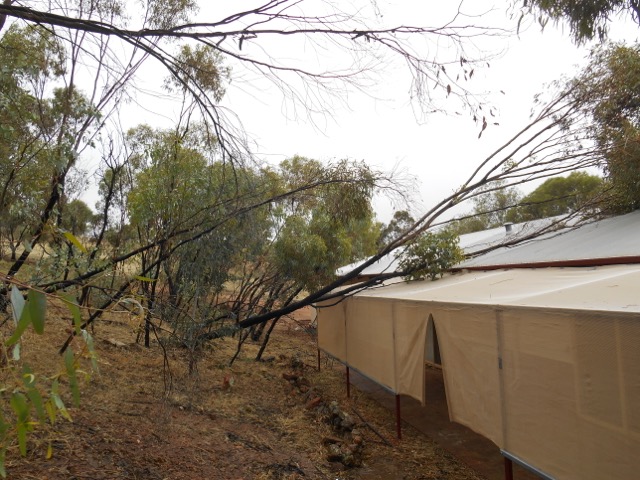
And then last night we received another dose of 75 mm, and woke to a tree down on the shade-cloth frame and the house roof. I had lain awake through much of the night and heard an almighty crash, and at first light looked out to the east because I suspected we might lose one of the trees out that way, but it was still standing.

Then Tim noticed one of the magnificent old-growth York gums down, one that grows on the tier above the house, just below the red shed’s level. Only two days ago I had caught a glimpse of a sleeping tawny frogmouth in the fork of its upper branches — numerous ring-necked parrots and galahs roosted in those branches, and it was part of the territorial stations of magpies and many other birds. Song-birds thrived in its blooms and around its lower branches.

But the tree that had likely made the crashing sound that alarmed me, was a younger tree, nonetheless quite tall, which had been uprooted and collapsed. I thought we’d have to call the SES, but decided to deal with it myself, given there was no hole in the roof, and given the pressure all services are under with flooding throughout the southwest, and given that we couldn’t expect assistance from our reliable friend John (‘Guru’), my mother’s partner, because they are literally flooded-in over near York, and their block is experiencing torrents.

York Gum down on house — trunk is about 20cm thick  at maximum and the whole was bringing a considerable
weight to bear. Sad loss.

Anyway, I spent an age working out the best way of dealing with the tree, sans a chainsaw (which I refuse to possess or use), and avoiding further damage to the roof.

I managed, using a bow saw, to cut the lower trunk partially, so it hinged down, lessening the load on frame, roof and trunk, and then once that load had been more evenly distributed, cut through and slide it from the roof.

I did the same with the next branch, and with some help from Tracy, we managed to ease the thick limbs down and away. Then I cut segments of the trunk down bit by bit. It was slow and dangerous work with the ground very unstable but it was done. I had then to saw up the tree and remove because over the next couple of weeks the fire risk will inevitably rise to ‘severe’ or even ‘catastrophic’ again, and we just can’t have swathes of eucalyptus leaves and branches piled up, drying close to the house.

As we deal with these bizarre weather patterns, tropical lows coming down fast from the north and cold fronts coming in west, I think of the fools in Parliament in Canberra taking lumps of coal in to make points about energy production.

We have handed our rights to self-determination and the rights of the biosphere over to fools. They live in their air-conditioned bubbles (in their mansions, in their offices, in the parliament, on their tractors) and can’t make simple links between cause and effect.

And here in Western Australia, the Western Australian government, private industry, and Main Roads, destroy every bit of vegetation they can lay their hands on. Cause and effect. Climate models. They want to live their lives now, without care for the future, and extract all they can. It’s brutal, selfish, and malignant.

So the reports are coming in: areas of Northam Shire are under evacuation orders as the Avon River rapidly rises. York is expecting a 4-metre peak and Toodyay similar. Walls of water moving fast and not to be toyed with.

There was no brook, stream, or winter creek here before — water is making its own way down to the Avon River from behind my mother's house.


Above photos taken by Wendy Kinsella over at York


Strangely, dealing with limbs of the old-growth tree pressing on other trees, and sawing away with the bow saw to relieve the pressure on those other trees already stressed with the softened ground, I noticed, in all the dirt thrown up around the torn and broken roots of the tree, clods of dry soil emerged from deep beneath its centre. I felt a weird anti-abjection that with all the mud and sogginess around actually made me viscerally sick, so incongruous was it.

Nearby was a puffball that had burst and set like concrete in the heat, and then being soaked in the deluge, had developed a black, mouldy patina. It was otherworldly, alien, and upset expectations of observation.

The entire landscape seems to have been given an injection of ghost, and the water still rushes out of the rocky soils of the hills, and gathers and flows down ‘Bird Gully’ to the valley below, to the valley where ancient flooded-gums had been burnt to their cores when someone’s burning-off got out of control some years ago. The dead trees parody their living selves sucking up no water, and the pobblebonks are always hidden mad in mid-summer with calling to the weirdness, the haunting. It’s like that, walking the bloody firebreaks, a skein of green coming up in the paddocks.

And so I write a poem, because it’s how I process disparate information, make sense of disjunctions between how I see something and how I experience it.

These trees we struggle for, watch daily as life evolves and revolves around them. I think of the wounds being inflicted along roadside, in paddocks, at the Beeliar wetlands, in nature reserves when someone wanting to fence makes more room for themselves, breaching the private and public, neo-colonists, and the broken, disrupted surfaces washing away under the deluge, and when the heat comes back fast and soon, blowing away as dust.

Everywhere around the district are new fences, and all the vegetation the fencers find an excuse to dismiss from life. And not far, those secretive ‘small-scale’ bauxite mines on private land, sending the essence of ecologies away to smelters. And few know, and few listen, so many struggles happening everywhere at once.

And so I write a poem, one of my new ‘Graphology Endgame’ series. Number 25, they are gathering. The lines are showing me a way I don’t wish to take, but am compelled to:

For all our preparations —
fixing gutters, making channels,
ensuring flows are as clear
as possible, the next instalment
of The Flood comes and puts
us in our place by dislodging
expectations — and then
a tree on dwelling,
our habits shaken,
and a bow-saw violining
the limbs, the trunk — that cutting
we push back against
in every other way,
always. Wetted soil,
dry at the core,
to replant
between extreme
weather conditions.
And tend. And let be.
-->

-->